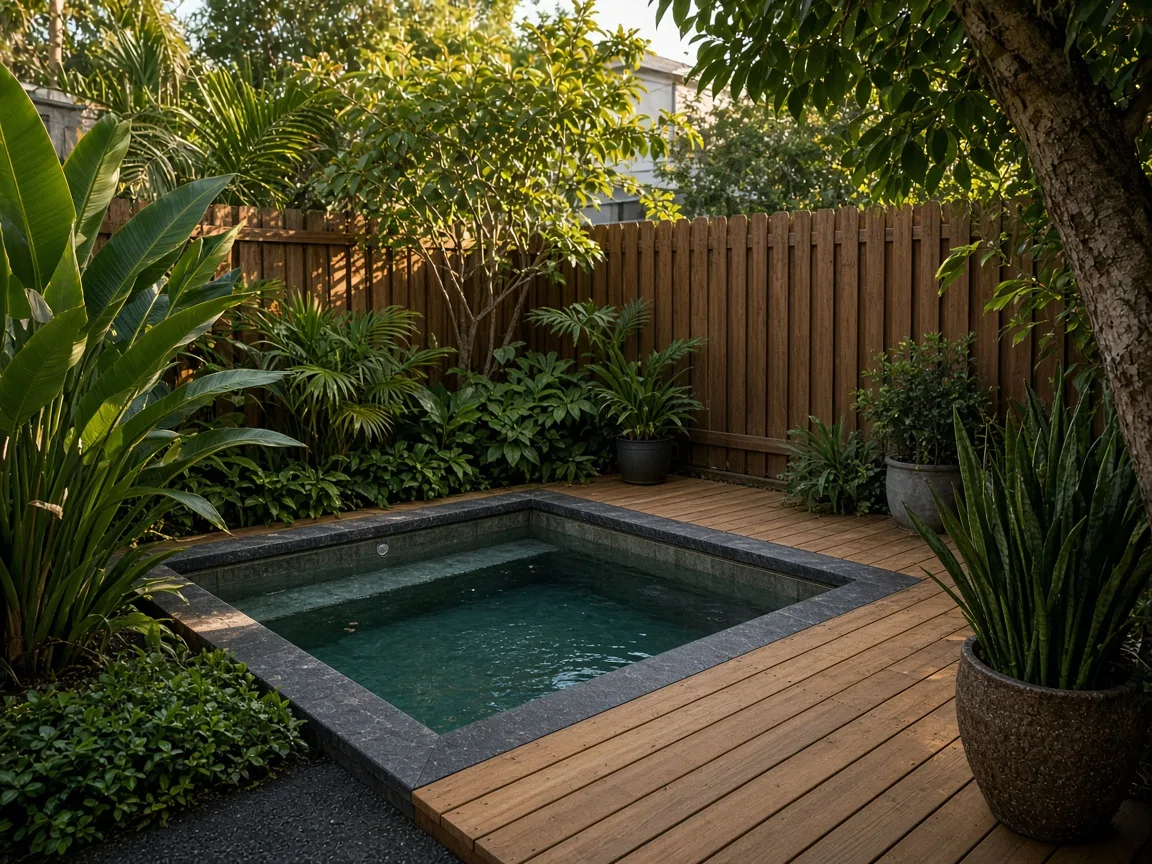
California backyards keep getting smaller, and water, energy and maintenance costs keep rising. That is why plunge pools and small "cocktail" pools have become one of the fastest-growing requests for builders from Los Angeles to San Jose. A small pool can deliver most of the enjoyment of a big one with a smaller footprint and lower running costs.
What counts as a plunge pool?
There is no official definition. Builders usually use "plunge pool" for a compact pool designed for cooling off, soaking and lounging rather than swimming laps. Many are roughly the size of a large spa up to a small pool, often with a uniform depth and built-in benches. "Small pool" or "cocktail pool" usually refers to something a bit bigger.
Typical options
- Custom gunite plunge pools. Fully custom size and shape, can include a heated spa mode and jets.
- Fiberglass plunge pools. Factory shells, often quick to install, where crane access allows.
- Precast concrete plunge pools. Delivered as a single concrete unit, an option offered by some specialty companies.
- Container-style pools. Shipping-container style units that are sometimes installed above ground or partly in-ground.
What does a plunge pool cost?
A plunge pool usually costs less than a full-size pool, but often not as little as people expect. Many costs are about the same whatever the pool size:
- Design, engineering and permits.
- Equipment: pump, filter, heater, sanitizer and automation.
- Electrical work and bonding.
- Safety features required by California law.
- Mobilizing crews and machines.
So the price per square foot of water is usually higher for small pools. Get itemized quotes and ask builders how much of the price is fixed.
Advantages of going small
- Fits tight lots. Leaves room for a patio, lawn or garden.
- Lower running costs. Less water to filter, treat and heat. A small pool can often be heated quickly and used year-round, which makes it attractive on the cooler coast.
- Less water use. Less evaporation and refilling.
- Faster to build in many cases.
- Spa-like use. Many owners heat a plunge pool to spa temperatures in winter and keep it cooler in summer.
Trade-offs
- Not suitable for real lap swimming (consider a narrow lap pool instead).
- Fewer features for kids who want to jump and play.
- Resale appeal depends on the neighborhood. In some areas buyers expect a full-size pool.
California rules still apply
A small pool still needs a building permit and must meet California's Swimming Pool Safety Act, which requires at least two of seven drowning-prevention features for new residential pools and spas. Setback rules from property lines, structures and easements apply too, and they can be the deciding factor on a tiny lot. Ask your builder to check setbacks before you fall in love with a design. Read more in our guide to pool permits and safety rules in California.
Average pool sizes for comparison
Residential pools in the US are commonly built in sizes around 12 by 24 feet up to about 20 by 40 feet. Plunge pools are much smaller, and many fall in the range of roughly 6 to 10 feet wide and 10 to 16 feet long. Your builder can show options that fit your yard.
Design tips
- Add a bench or tanning ledge so the pool works as a lounging space.
- Consider a cover, either a safety cover that also counts as a drowning-prevention feature or an automatic cover.
- Plan heating early. A heat pump is popular for small pools in mild climates.
- Use the pool as a water feature. Sheer descents, lighting and the right tile turn a small pool into the focal point of the yard.
- Keep the equipment pad quiet and screened, since in small yards it is close to everything.
Bottom line
A plunge pool can be the smartest pool for a compact California yard, but expect fixed costs to make it pricier per square foot than a big pool. Talk with two or three licensed local builders about setbacks, heating and safety features, then compare itemized bids.
Finding a pool builder near you
Our directory covers every California city with at least 20,000 residents. Each city page ranks local pool builders by Google rating weighted by review count, so a builder with hundreds of strong reviews ranks above one with a handful. Where we could confidently match a business to the Contractors State License Board's public license file, we show a CSLB License Verified badge with the license number. Use the filters on each city page to narrow the list to gunite, fiberglass, spa, remodel or decking specialists, then request quotes from at least three builders.
Frequently asked questions
Is a plunge pool cheaper than a regular pool?
Usually yes in total, but less than people expect, since permits, equipment, electrical and safety features cost about the same regardless of size.
Does a plunge pool need a permit in California?
Yes. An in-ground plunge pool needs a building permit and must meet the state's drowning-prevention requirements and local setback rules.
Can you heat a plunge pool year-round?
Yes. Small water volume heats faster, so many California owners use plunge pools like a spa in winter.
What is the smallest pool you can build?
Builders can make very small custom pools, but local setbacks, equipment space and your intended use usually set the practical minimum.
This guide is general information, not legal, tax or financial advice. Costs vary by property and builder. Last updated November 2026.